


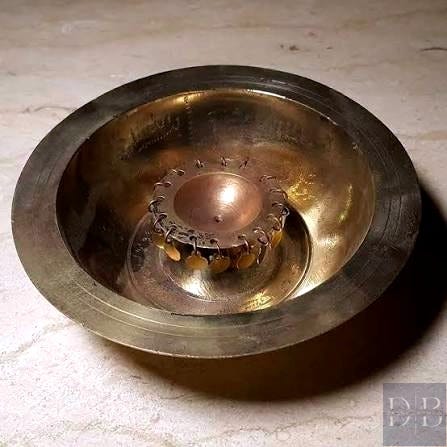
Look at this object. What do you see? You might think it could be a bowl, an ashtray, a decorative brass dish, a candle holder, or a broken mechanical part. You are already interpreting it, you are not merely seeing metal, you are naming it, categorizing it, placing it inside a structure of meaning. Every suggestion that came to your mind came from something you already know.
If you have seen antique candle holders, you might think candle holder, if you grew up around Middle Eastern decor, you might think incense burner. If you have mechanical training, you might think gear housing. If you have seen ceremonial vessels, you might think ritual artifact. You are not inventing meaning, you are retrieving it.
No one expects you to correctly identify something you have never encountered before. Recognition requires prior familiarity. Interpretation requires stored categories. We do not approach objects neutrally. We approach them with memory, language, and training.
Hans-Georg Gadamer called this our “horizon.” A horizon is the range of vision that includes everything that can be seen from a particular vantage point. It is shaped by history, education, culture, and language. Understanding, Gadamer argued, is always a “fusion of horizons” between what confronts us and what we already carry.
Martin Heidegger argued that understanding is not something we occasionally do; it is the condition of being human. We always interpret through prior structures. We never encounter raw facts detached from context. We encounter meaning through fore-understanding.
Thomas Kuhn demonstrated something similar in science. Scientists operating under one paradigm literally see different things than those under another. The data does not change. The interpretive framework does.
The object in front of you did not change while you were guessing what it might be. What changed was the horizon you applied to it. This is how human perception works. We see through what we know.
The Formation of the Western Horizon
From late antiquity through the medieval period, Christianity was institutionally fused with empire. After Constantine, the Church became intertwined with imperial administration. Bishops advised emperors. Councils shaped law. Orthodoxy and political stability became mutually reinforcing categories. As centuries unfolded, this fusion hardened. The medieval Church accumulated land, taxation authority, courts, armies, and diplomatic leverage. Popes crowned kings. Kings appointed bishops. The sacred and the territorial overlapped so thoroughly that Europe could no longer distinguish between theological claims and geopolitical strategy.
The holy wars of Europe were not theological eruptions. They were entangled in trade routes, Byzantine politics, papal authority struggles, land redistribution, and feudal ambition. Yet because they were mobilized under the cross, they entered European memory as “religious wars.” The violence of territorial expansion was interpreted as the violence of belief.
The Inquisition operated within complex power dynamics, royal consolidation in Spain, social control, economic seizure of property, ethnic suspicion, and emerging state formation. But its language was theological. Therefore its coercion was attributed to theology itself.
What began as confessional conflict between Catholic and Protestant blocs devolved into one of the most destructive wars in European history. Entire regions of the Holy Roman Empire were devastated. Population collapse, famine, mercenary violence, economic ruin, Europe internalized this trauma as “religious war.”
Philosophers such as Hobbes, Locke, Voltaire, and later Rousseau were reacting to European bloodshed. Hobbes’ Leviathan was not primarily an anti-Christian treatise. It was a response to civil war. His solution was the centralization of power in a sovereign capable of suppressing confessional conflict. Religion, in his schema, had to be subordinated to political authority to preserve peace. Voltaire’s famous cry, “Écrasez l’infâme,”