


Muslims insist that Islam is the purest, most uncompromising form of monotheism, the very standard by which they condemn Christians for worshipping the Trinity and Jews for allegedly elevating Uzayr (Ezra) to divine sonship, a charge that has no footing in Jewish texts or history. Muhammad, it seems, needed to invent that particular slander to make the accusation stick.
But the claim that Islam alone delivers untainted monotheism begins to fracture the moment we look beneath the surface. It weakens first when we notice how completely Muhammad has, in practice, eclipsed Allah in the hearts and daily devotions of Muslims (a displacement I’ve explored elsewhere). It shatters again when we examine where Islamic rituals actually came from.
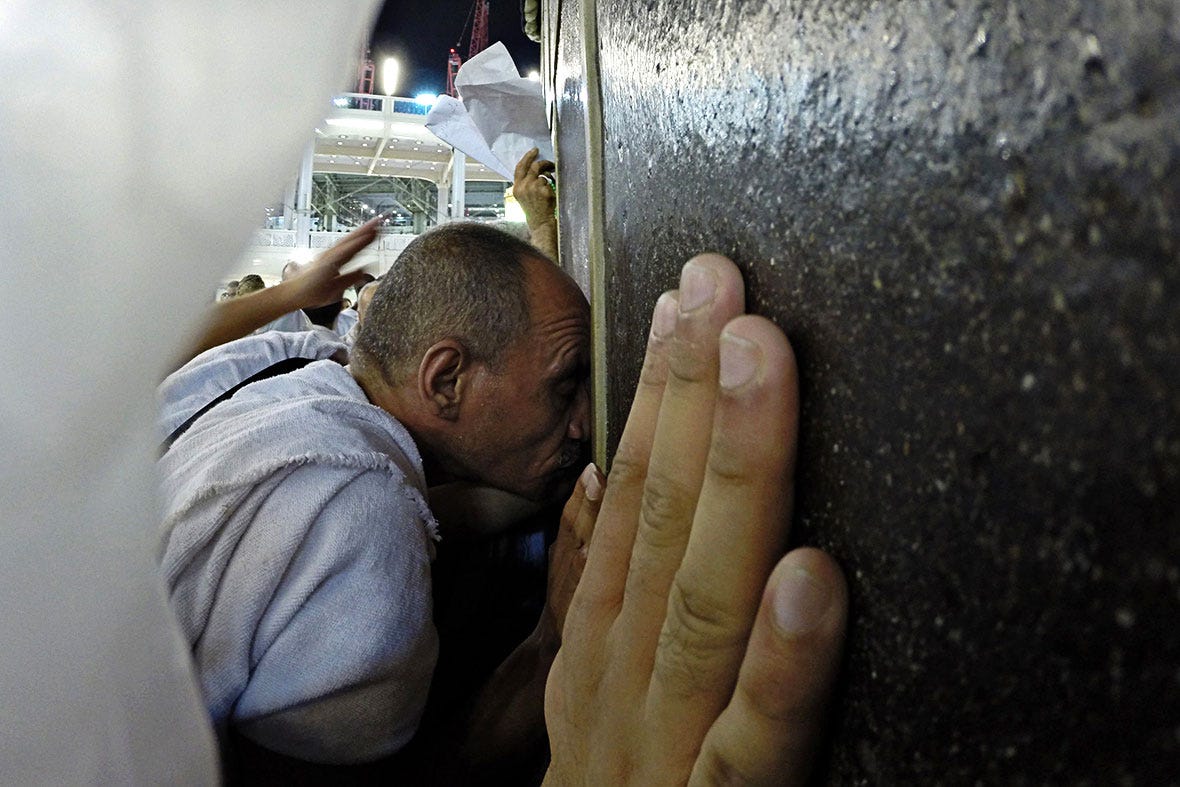
A few days ago I watched live footage of the Umra (similar to Hajj): thousands of men and women pressing in suffocating waves around the Kaaba, bodies climbing over bodies, hands clawing toward a single black stone set in silver, lips and foreheads desperate to touch it. The chaos, the fervor, the physical desperation, it looked less like worship of an invisible Creator and more like an ancient rite that refused to die. That image is what finally pushed me to write this plain look at the pagan roots of Islam.
Identity Theft
Allah was never the invisible, transcendent, jealous, one-and-only Creator who thundered from Sinai and sent prophets to Israel. That was never his face in pre-Islamic Arabia. He was already on the scene, centuries before Muhammad, as a fixture in the Meccan pantheon: a high god, sure, but a pagan high god, enthroned above a family of lesser deities, daughters, consorts, and intercessors who handled the day-to-day divine dirty work. Islam didn’t discover Allah. It hijacked him. It stripped the polytheistic fingerprints, slapped on borrowed Abrahamic rhetoric, and marketed him to the world as the same God who spoke to Moses, drowned Pharaoh, and fathered Jesus through the Holy Spirit. This was one of the most audacious theological identity thefts in human history.
In Jahili Mecca, Allah was never solitary. The Quran, trying to score points, accidentally confesses time after time that the Quraysh and their neighbors already confessed Allah as creator of the heavens and earth, sender of rain, reviver of the dead, controller of destiny (29:61; 31:25; 39:38). But they “associated” partners with him, daughters, helpers, intercessors, exactly the way every ancient Near Eastern polytheist had done for three thousand years: El in Canaan had Asherah and a divine council; Baal-Shamem in Syria had his consort and attendants; Zeus Hypsistos in the Hellenistic world had a whole heavenly bureaucracy. The Meccans were textbook henotheists: one boss god at the top, a loyal supporting cast underneath, and Allah was their undisputed kingpin.