


British writer Edmund Burke argued that civilization is not the product of the many, and never has been. It is the product of the few, the natural aristocracy (Greek for “rule of the best”): men of genuine learning, long-term perspective, and the cultivated capacity for judgment that comes only from a disciplined engagement with history, philosophy, law, and the accumulated experience of civilization across time.
America was built by exactly this class. The founders were the most formidable concentration of intellectual aristocracy that any political founding has ever produced. In his 1813 letter to John Adams, Jefferson described the natural aristocracy as the most precious gift of nature for the instruction, the trusts, and the government of society, and that the best form of government is that which most effectively provides for a pure selection of these natural aristoi into the offices of government.
This intellectual aristocracy did not merely found America. It sustained it through successive generations of genuine thinkers, genuine statesmen, genuine jurists and scholars and writers who understood their role as custodians of an inheritance rather than as autonomous agents free to remake the republic according to their own theoretical preferences.
The civilization they built and sustained, imperfect, yet genuinely extraordinary in its productive, creative, and institutional achievements, was their product. Not the product of masses. Not the product of the street. Not the product of the aggrieved and the organized and the permanently resentful. The product of a class of human beings who had been formed by a specific kind of intellectual culture and who exercised their formation in the service of something larger than their own immediate interests.
Burke’s position was not elitism in the pejorative sense. It rests on the recognition that political knowledge is not the sort of thing that can be extracted from books or deduced from abstract principles. It is a craft, transmitted through tradition and apprenticeship, and available only to those who have been genuinely formed by it.
The wisdom embedded in inherited institutions accumulates slowly across generations. It cannot be reconstructed from scratch by any single generation, no matter how intelligent. The role of the natural intellectual aristocracy is precisely to serve as the living transmission belt for this accumulated wisdom.
What the Aristocracy Knew
The great civilizations of history have never been built by starting from scratch. They have been built by inheritance, by the transmission of accumulated knowledge, accumulated judgment, and accumulated institutional wisdom from one generation of genuinely formed human beings to the next, each generation adding to what it received, refining what it inherited, and passing forward something richer and more adequate to the demands of reality than what it had been given. This is what Burke meant by the partnership between the dead, the living, and the unborn, not a sentimental attachment to the past but a structural observation about how civilizational knowledge actually accumulates and what happens to a civilization that severs the transmission.
The American intellectual aristocracy was the most successful example of this transmission in the modern world. What Madison received from Montesquieu and Locke and the long tradition of English constitutional thought, he refined through his own extraordinary engagement with the evidence of every previous republican experiment and passed forward in the form of a constitutional architecture so precisely calibrated to the permanent tendencies of human nature, the will to power, the corruption of faction, the tyranny of majority passion, that it has outlasted every other written constitution in history. What Lincoln received from Madison and Jefferson, the proposition that free government was possible, that a republic could sustain itself against the permanent pressure of its own internal contradictions, he tested against the most severe crisis any constitutional order has ever faced and passed forward, tempered by that testing, as something harder and more durable than what he had inherited.
The first great addition of the twentieth century was the identification of communism as a civilizational threat of a kind that the previous tradition had not encountered and for which the existing intellectual vocabulary was initially inadequate. Woodrow Wilson’s generation saw it coming but could not yet fully characterize it. It was the generation of George Kennan, Reinhold Niebuhr, Dean Acheson, Paul Nitze, and Daniel Patrick Moynihan that developed the full analysis, and what they developed was a civilizational diagnosis of what communism actually was and why it was incompatible not just with American interests but with the conditions under which human beings could live as genuinely human beings.
Kennan’s containment doctrine was an argument that a political system whose foundational premises required the destruction of civil society, the abolition of private property, the elimination of all institutional space between the individual and the state, and the subordination of all human activity to the revolutionary project, was not a rival civilization with which America could indefinitely coexist but a pathology that would either be contained until it exhausted itself from within or would expand until it had consumed everything outside it.
The twentieth century’s grim laboratory confirmed Kennan’s analysis. Russia. China. Eastern Europe. Southeast Asia. Cuba. Sub-Saharan Africa. Wherever the system was implemented at scale the results were identical, mass famine, political terror, the Gulag, the Cultural Revolution, the Killing Fields, not as aberrations but as the structural and inevitable consequences.
Niebuhr added the theological and moral depth. His Christian realism, the insistence that human beings are simultaneously capable of genuine moral achievement and permanently susceptible to the corruption of power, that no political program can redeem human nature, and that the appropriate response to this condition is not utopian transformation but the construction of institutions adequate to managing human nature’s worst tendencies while enabling its best, was the intellectual framework that allowed the American intellectual aristocracy to oppose communism morally. Niebuhr could criticize American conduct in the world, and did, with considerable force, without thereby abandoning the judgment that the American constitutional order was genuinely superior to what communism offered, because his formation gave him the capacity to hold both truths simultaneously without resolving the tension between them prematurely in either direction. T
Moynihan extended the inheritance in a different direction, toward the specific institutional and social conditions that free societies require to sustain themselves, and toward the identification of the internal threats that democratic cultures generate from within even in the absence of external ideological pressure. His analysis of the breakdown of the family in urban African American communities, savagely attacked at the time as racist by people who could not distinguish between identifying a problem and endorsing the conditions that produced it, was a piece of genuine social science in the tradition of Tocqueville, the kind of work that only a person of genuine formation could produce because it required the willingness to follow evidence to conclusions that were institutionally costly and socially uncomfortable. His defense of Israel at the United Nations, Zionism is not racism, delivered in 1975 with a moral clarity and a rhetorical force that his opponents could not match, was the aristocracy’s inheritance speaking at the height of its power, the accumulated civilizational understanding of what Israel represented and what its delegitimization would mean.
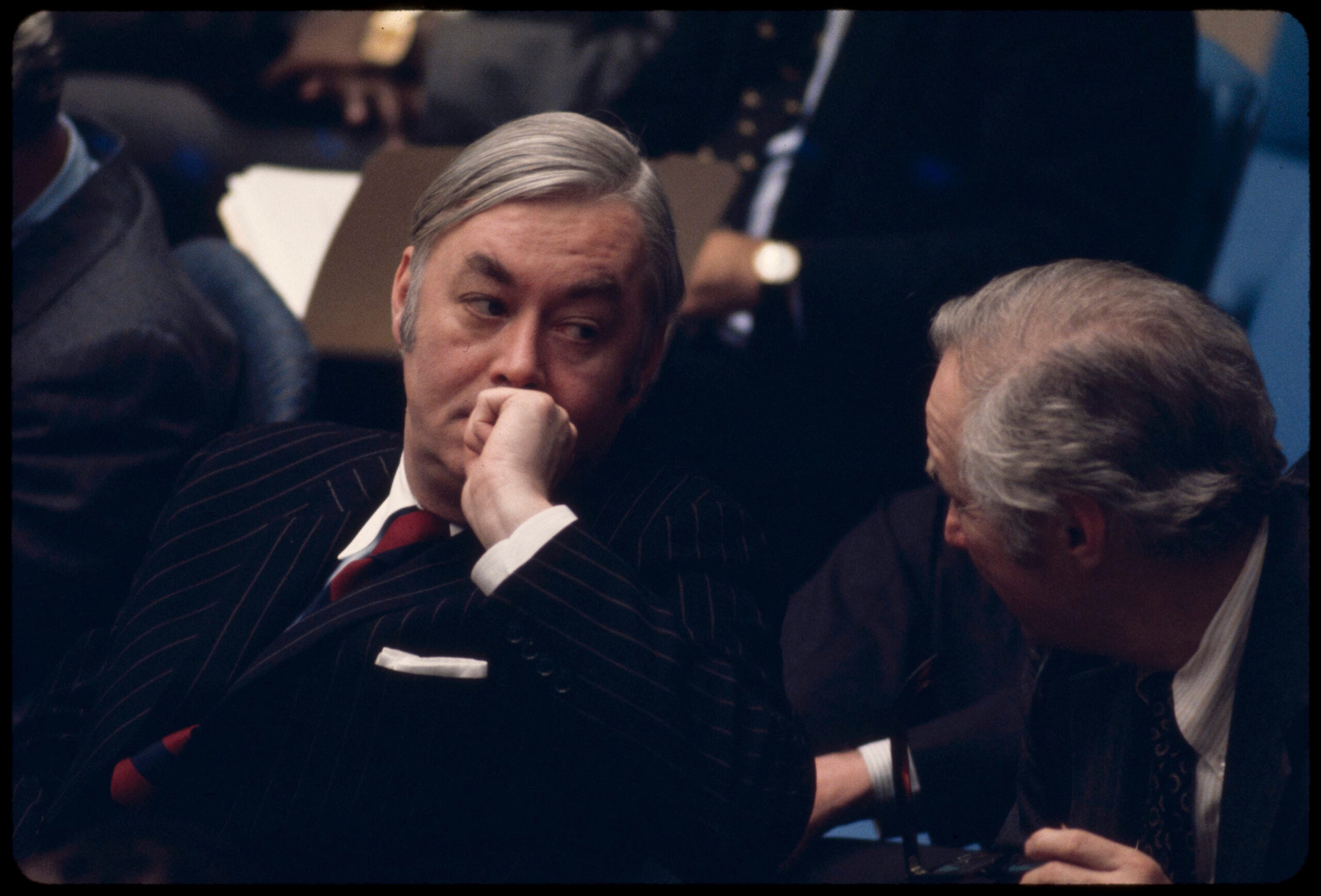
The pro-Israel position of the American intellectual aristocracy was never tribal and never sentimental. It was the logical expression of the same civilizational analysis that grounded everything else they believed. Truman recognized Israel in 1948 over his own State Department’s objections because he understood what the serious liberal tradition had always understood that a liberal democracy taking root in the most hostile possible environment was not merely a Jewish achievement or an American strategic interest but a proof of concept for the principles on which the American republic itself rested. If those principles could survive and flourish surrounded by neighbors whose explicit purpose was their annihilation, the proposition that free government was possible was strengthened in a way that no domestic achievement alone could accomplish. The subsequent record, the only genuine liberal democracy in the Middle East, the most innovative economy per capita in its region, the civilian control of the military through existential wars, the Nobel laureates, the contributions to medicine and agriculture and technology, all sustained against odds that would have destroyed any less durable political culture, was not just Israel’s achievement. It was the aristocracy’s civilizational judgment vindicated in the most demanding possible test of its accuracy.
The identification of Islam’s incompatibility with Western principles was similarly not the product of post-September 11 anxiety or neoconservative ideology. It was an old layer of the inheritance, the conclusion that Jefferson drew from his conversation with the Tripolitan ambassador in 1786 and reported to Congress. What Jefferson understood, that Islam made peaceful coexistence with non-Muslim sovereignty permanently provisional and ultimately impossible, that this was not a misunderstanding to be resolved through dialogue but a structural feature of a theological system whose foundational premises required the subordination of all political authority to divine law was the a layer on which every subsequent generation of the aristocracy built its understanding of what America faced in its encounters with Islam. The Barbary Wars were not an aberration. They were the first chapter of a story whose subsequent chapters, from the Ottoman collapse through the Iranian Revolution through September 11 through October 7, have confirmed Jefferson’s founding analysis with a consistency that the aristocracy’s successors acknowledged for a very long time.
American exceptionalism was the synthesis that held all of these positions together. The conviction that America represented something genuinely extraordinary in the history of human self-governance was not nationalism in the vulgar sense. It was a structural observation about what the American founding had achieved and what sustained it, the observation that a specific combination of constitutional architecture, cultural formation, historical-theological inheritance, and institutional design had produced a political order of unusual durability, unusual capacity for self-correction, and unusual ability to extend the conditions of human freedom to an expanding population across radical changes in circumstance. Lincoln called it the last best hope of earth not as a boast but as an assessment of the stakes, the judgment that if free government failed here, having been given the most favorable conditions that history had ever provided for its success, the case for its possibility anywhere would be severely damaged.
The aristocracy that maintained this inheritance across the twentieth century, that opposed communism, defended Israel, understood Islam, and held American exceptionalism, did so because their formation had brought them, through genuine intellectual struggle, to conclusions that the evidence demanded and that genuine custodianship of the civilization required. They were not always right in their specific judgments. They were wrong about specific policies, specific interventions, specific applications of the general principles they had inherited. But they were right about the foundations, about what the civilization they were custodians of represented, what threatened it, and what defending it required. And the civilization they produced and sustained, the most extraordinary experiment in human self-governance that the world has seen, the civilization that defeated fascism and communism and built the most prosperous and most free international order in human history, is the most powerful and most honest argument for the soundness of what they knew.
The Counterfeit Aristocracy
Society, for most of recorded history, was brutally simple in its structure. At the top sat the aristocracy, and at the bottom sat the vast peasant majority, illiterate, unformed, living entirely within the horizon of immediate material survival, with no access to the accumulated wisdom of civilization and no institutional mechanism through which to acquire it. Then commerce happened, trade expanded, markets developed. A new class emerged from the peasant majority, people who had found, through the accumulation of material capital, the means to purchase the outward markers of aristocratic life without undergoing the formation that had produced them.
The aristocrat who hung a painting in his gallery was engaging in an act of genuine cultural participation, he had been formed to understand what he was looking at, to situate it within the history of artistic achievement, to experience it as an expression of the civilization whose custodian he understood himself to be. The painting meant something to him that was independent of what it signaled to others. The bourgeois who hung the same painting in his newly acquired townhouse was engaged in a fundamentally different act, an act of display, of social signaling, of purchasing the appearance of belonging to a cultural world whose inner life remained inaccessible to him because the formation that would have made it accessible was precisely what commerce could not buy. He bought the painting for spectacle. The aristocrat bought it for substance. To the casual observer the two acts were indistinguishable.