


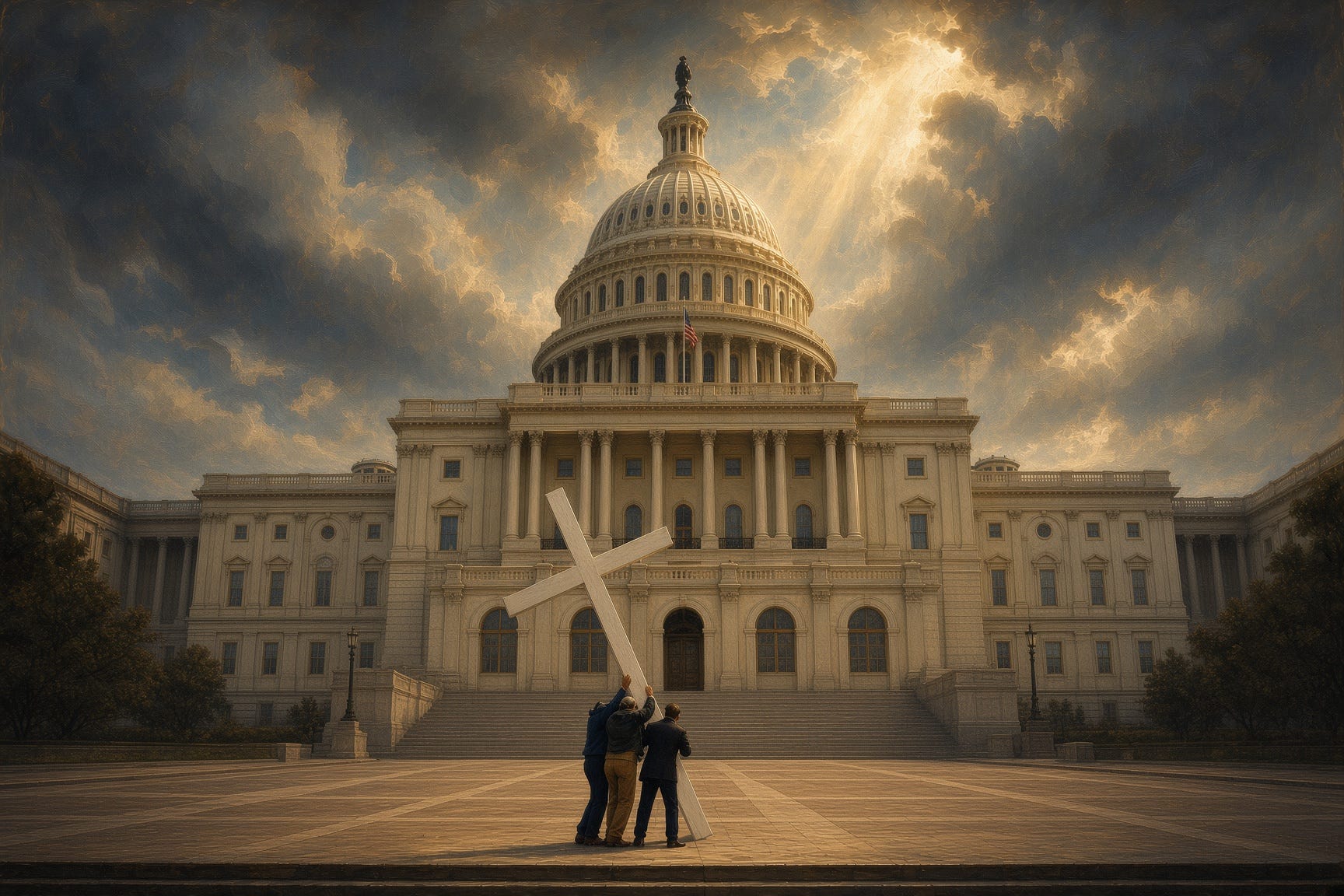
I do not oppose the Islamic caliphate because it is Islamic. Yes, I left Islam and believe it is the most destructive ideology that has ever existed, but my objection to the caliphate is political. An Islamic government would never treat all men as equal citizens under a common law. It sorts people by religion and by sex, elevates religious law above private conscience, and gives the state enormous power over belief, family, law, and public life. Systems built this way shape people to be slaves, train them to obey, and eventually produce subjects who celebrate their submission as virtue.
But Islam did not invent this system. Throughout human history, this was simply the political order, the human default, not the exception. From the pharaohs to the kings of Mesopotamia to the Roman emperors, rulers repeatedly wrapped political authority in divinity, and European monarchs later claimed that their thrones rested on God’s appointment. When the modern world began pushing God out of politics, totalitarian movements kept the same structure and changed only the source of authority. The Party took God’s place, or the revolution, or the race, or the leader.
Under all of these systems, ordinary people were never truly free, never equal before the law, and never collectively prosperous. Rights, where they existed at all, were distributed according to class, religion, sex, caste, tribe, or proximity to power. Discrimination was built into the political order, dissent could be punished as disloyalty or heresy, and the individual possessed few protections against the ruler. Wealth might accumulate around courts, temples, armies, party elites, or ruling families, but the population as a whole remained politically subordinate, economically vulnerable, and dependent on those above them. Some empires were rich, some were powerful, and some produced great art, architecture, and learning, but none produced the combination of individual rights, equality before the law, religious liberty, political participation, social mobility, widespread prosperity, and longevity that emerged under the American constitutional order.
Every political system has defects, including America’s, but measured against the alternatives human beings have tried, the American experiment has produced fewer political defects and more shared human flourishing than any previous, or current, model of government.
American Exceptionalism
Every other political order in history failed to deliver what the American political order delivered. Monarchies concentrated power in dynasties. Aristocracies made political privilege hereditary. Theocracies subordinated citizenship to religious status. Empires divided conqueror from conquered. Communist regimes abolished private concentrations of wealth only to create political elites with vastly greater power. Fascist regimes subordinated the individual to the state and murdered millions in the process. Even Europe’s liberal democracies did not grant their people the degree of political and religious freedom Americans enjoy. The French Revolution itself followed the American Revolution and drew on its language and ideals.
America became the largest economy in the world by the end of the nineteenth century and then the dominant industrial power of the twentieth. It became the destination of tens of millions of immigrants. It produced unprecedented levels of mass homeownership, consumer abundance, technological innovation, private philanthropy, higher education, and upward mobility. It created enough wealth not merely for kings or merchants, but for ordinary workers, forms of material abundance that would have been unimaginable luxuries throughout human history and that remain beyond the reach of much of the world today.
America’s superiority is not only economic. It is also political, legal, and personal. Americans enjoy protections for freedom of speech, religious liberty, political dissent, private association, due process, and protection from arbitrary government that are not found even in the other developed democracies.
In England and Wales, more than 12,000 people were arrested in 2023 under communications laws covering allegedly offensive or malicious speech.
America is a country where a citizen can insult the government, mock religion, denounce the president, start a movement, open a business, lose everything, fail publicly, and rise again. That freedom creates a kind of human dignity that cannot be measured by GDP alone. America built something people across the world still aspire to join. It is the envy of the world not only because of its wealth, but because of the kind of person its political order builds: free. Those of us who came here as immigrants understand this more than people who were born into it. We know what it is to live outside this order and then to be received into it, shaped by it, and made one of its own. For those who truly escaped to America both physically and culturally, that creates a debt of gratitude that lasts a lifetime.
A Brief Desperation
In 1929, the American economy began to fall apart. By 1933, millions of Americans had lost jobs, savings, homes, farms, or businesses. For a generation raised to believe in the basic tenets of the American political order, individual freedom, limited government, private property, free enterprise, personal responsibility, and the idea that people should largely be free to build their own lives, the Depression was more than an economic catastrophe. It shook their confidence in the system itself. For the first time, millions of Americans began to wonder whether the political and economic order that had produced so much freedom and prosperity could still keep its promises.
By the early 1930s, the Soviet Union was already showing the brutality of forced collectivization, repression, famine, and political terror. But the full historical record had not yet accumulated. Stalin’s purges, the Gulag on its later scale, Mao’s Great Leap Forward, the Cultural Revolution, and decades of economic failure were still ahead. To an unemployed American worker in 1932, socialism could still be sold as a glamorous promise.
That crisis of confidence became the central issue of the 1932 presidential election. The incumbent Republican president, Herbert Hoover, still believed that the American system could recover without permanently transforming the role of the federal government. His Democratic challenger, Franklin D. Roosevelt, argued that the scale of the collapse demanded a far more aggressive response from Washington, and proposed a much larger federal role in banking, labor, welfare, agriculture, and economic regulation.
Hoover described the election as something larger than a choice between two candidates; he called it a contest between “two philosophies of government.” What frightened him was the possibility that economic desperation would persuade Americans to surrender powers to Washington that would never fully be returned. He feared that once citizens began looking to the federal government for economic security, the relationship between the individual and the state would be permanently altered.
Roosevelt won overwhelmingly, and once in office he began expanding the federal government on a scale Americans had never seen before. Social Security created a permanent federal role in retirement security. Washington became more deeply involved in banking, financial markets, labor relations, unemployment relief, and agriculture. Even after the immediate crisis passed, much of this new machinery remained. To Hoover and many conservatives, this confirmed exactly what they had feared: measures introduced as emergency responses were becoming permanent institutions, moving responsibility away from individuals, families, communities, and states and toward Washington.
What Roosevelt called necessary reform, his opponents saw as the beginning of dependence on the federal government and a dangerous movement toward socialism that could eventually threaten the liberty the American system had been built to protect.
Roosevelt saw the danger differently. He understood that if millions of Americans came to believe that capitalism meant nothing more than the freedom to lose everything, socialism would become harder and harder to resist. You could not protect the American system simply by telling desperate people to trust it. You had to show that the system could correct itself. That is what Roosevelt tried to do. He was willing to experiment with policies that many conservatives considered socialist, but he never embraced the socialist project itself. He did not abolish private property, nationalize American industry, replace elections with one-party rule, or hand the economy over to central planners. He looked at the grievances that made socialism attractive and asked which of them were legitimate.
If an elderly man could work his whole life and still end up destitute, perhaps some form of old-age insurance made sense. If millions of men were unemployed because the entire economy had collapsed, perhaps unemployment was not always a moral failure. If a bank could gamble recklessly and wipe out the savings of thousands of families, perhaps banking needed rules strong enough to restore public trust.
Roosevelt took from socialism what could strengthen the American system and rejected what would destroy it.
Roosevelt was playing with fire, and Hoover was right to warn that fire can spread. But Roosevelt was also a product of the political order he was trying to save. The divide in America at that moment was not between one camp that loved America and another that saw America itself as evil. Roosevelt did not believe the Constitution had to be replaced, that the American founding was fundamentally illegitimate, or that capitalism had to be destroyed and replaced with a new political order. He believed America was great and worth preserving, and his reforms were intended to preserve it. That made experimentation with ideas drawn from another political order far less dangerous.
The Desperation of the Prosperous
Nearly a century later, America is again living through a crisis of confidence. But this crisis comes after generations of Americans have lived within an economic order that made levels of comfort once reserved for kings available to ordinary people. Entire generations have come to regard that abundance not as a historical miracle, but as the normal starting point of life. When a society has been prosperous for long enough, even a setback can feel like total failure, because people compare their lives not with the rest of human history, or even with most of the world today, but with the unusually favorable conditions enjoyed by the generation immediately before them.