


The story of Abraham begins with a promise that could not be fulfilled by human means. God told Abram to leave his country and his father’s house and promised to make him “a great nation.” But a nation requires a son, and Abram had none. Genesis states that: “Sarai was childless because she was not able to conceive.” The promise was given to the one household that could not produce its own fulfillment.
Years passed without a child. When God appeared to Abram again, Abram said to him, “Sovereign Lord, what can you give me since I remain childless?” His heir, he said, would be his servant, Eliezer of Damascus. God rejected that possibility: “This man will not be your heir, but a son who is your own flesh and blood will be your heir.” Then God took Abram outside, told him to look up at the sky and count the stars, if he could, and said, “So shall your offspring be.”
After ten years in Canaan, Abram and Sarai still had no son, and after waiting that long, they began to think it was up to them to save themselves. So Sarai proposed a solution: “The Lord has kept me from having children. Go, sleep with my slave; perhaps I can build a family through her.” Genesis records his response in words that deliberately echo God’s charge against Adam: “Abram listened to Sarai.”
By the standards of the time, this was not scandalous. Contracts from the ancient Near East, including tablets from Nuzi, show arrangements in which a barren wife gave her slave to her husband so that the resulting child could legally belong to her household. By listening to Sarai, Abram tried to fulfill God’s promise by his own methods.
The book of Genesis describes what kind of man this son, who was named Ishmael, would be: “He will be a wild donkey of a man; his hand will be against everyone and everyone’s hand against him, and he will live in hostility toward all his brothers.” The Hebrew is pere adam, “a wild donkey of a man.” The son born from Abram’s own effort would live in permanent conflict with those around him.
Islam traces its lineage through Ishmael. Symbolically, Abraham’s attempt to save himself produced exactly what the angel described: a wild nation whose hand is against every nation, and every nation’s hand against it.
This is what happens when people try to escape an impossible situation by their own power. Sarai could not have a son, and Abraham had no way to make it happen. That is precisely why God promised it. A son through Hagar required no miracle. It was within Abraham’s reach, and he would not have needed a promise from God to get it. The promise was attached to the impossible because only God could fulfill it.
Thirteen Centuries of Waiting
When the Arab armies took Syria, Iraq, and Egypt in the 630s and 640s, they conquered lands that were overwhelmingly Christian. Damascus, Antioch, Jerusalem, and Alexandria were among the great centers of the Christian world. Within a few years, the Christians who lived there became a subject population. They kept that status for roughly thirteen centuries.
Christians were dhimmis, non-Muslims who were allowed to live under Islamic rule and keep their religion in exchange for accepting the rule of Islam and paying the jizya. The payment was not only revenue, it was a public acknowledgment of inferiority, and a deliberate act of humiliation.
Christians agreed not to build new churches or repair old ones in Muslim areas. They agreed not to display crosses publicly, ring church bells loudly, or pray aloud where Muslims could hear. They agreed not to prevent any member of their community from converting to Islam, and not to try to convert any Muslim. They agreed to wear distinctive clothing, not to ride horses with saddles, not to carry weapons, not to build houses taller than those of Muslims, and to rise from their seats when a Muslim wished to sit.
A Christian’s testimony was not accepted against a Muslim. A Muslim is not to be killed for killing a Christian. Blood money for a Christian was set at half or a third of that for a Muslim. A Christian man could not marry a Muslim woman, while a Muslim man could marry a Christian woman and their children were raised Muslim. A Christian could become a Muslim at any time. A Muslim who became a Christian faced death for apostasy.
The result was a slow and steady subtraction. Egypt, Syria, and Iraq, which had been Christian majorities, became Christian minorities, and then small minorities. Coptic in Egypt and Syriac across the Levant and Mesopotamia gave way to Arabic, until the old languages survived mainly in the liturgy.
None of this means Christians were persecuted without pause for thirteen hundred years. There were long periods of relative calm. Christians served as physicians, translators, and financial administrators to caliphs. Nestorian scholars translated Greek philosophy into Arabic in Abbasid Baghdad. Copts ran much of Egypt’s tax bureaucracy for centuries. But that tolerance was granted by rulers, not guaranteed as a right, and what a ruler grants he can withdraw.
The Abbasid caliph al-Mutawakkil ordered Christians in the ninth century to wear yellow garments and to nail wooden images of devils to their doors. The Fatimid caliph al-Hakim ordered the destruction of the Church of the Holy Sepulchre in 1009. Mob attacks burned churches across Mamluk Egypt in the fourteenth century. The periods of calm were real, but they depended entirely on the goodwill of whoever held power. A dhimmi was protected in the way property is protected. He had a guardian, not rights.
A Promise from Istanbul
On November 3, 1839, in the rose garden of Topkapi Palace, the Ottoman foreign minister Mustafa Reshid Pasha read a decree before the assembled officials of the Caliphate, foreign ambassadors, and representatives of the non-Muslim communities. It was issued in the name of the new sultan, Abdulmecid, who was sixteen years old. The decree promised all Ottoman subjects security of life, honor, and property, and fair and public trials, and it applied these guarantees to every subject “of whatever religion or sect.” It became known as the Edict of Gulhane, and it opened the period of reform the Ottomans called the Tanzimat, “the reorderings.”
For the first time since the conquests of the seventh century, an Islamic state had declared in law that a Christian’s life and property carried the same protection as a Muslim’s. Seventeen years later, the empire went further.
To understand why, one has to understand how desperate the empire had become.
By the early nineteenth century, the Ottoman state was losing. The Treaty of Kucuk Kaynarca in 1774 had ended a disastrous war with Russia, and Russia afterward claimed the right to speak on behalf of the empire’s Orthodox Christians. Millions of the sultan’s subjects now had a foreign patron with an army. Serbia won autonomy after a series of revolts. The Greeks rose in 1821 and, with British, French, and Russian help, won full independence in 1830. Christian subjects who felt they had no future under Islam would look for one outside it, and the great powers of Europe would help them.
The most dangerous threat came from within the Islamic world itself. Muhammad Ali, the Ottoman governor of Egypt, had built a modern army and turned it against his sovereign. In 1831 his son Ibrahim Pasha invaded Syria, defeated the Ottoman army, and marched into Anatolia. In June 1839, Egyptian forces crushed the Ottomans again at Nezib. Days later Sultan Mahmud II died, and the Ottoman fleet sailed to Alexandria and defected to Egypt. The empire had lost its army, its navy, and its sultan in a single summer. Only European intervention could save it, and Britain was prepared to intervene, but it expected reform in return.
The Edict of Gulhane was issued four months after Nezib. It was written by a man who had served as ambassador in London and Paris and understood what Europe wanted to hear. The following year, Britain and its allies forced Muhammad Ali out of Syria. The reform and the rescue came as a package.
Syria had already seen a preview. During the Egyptian occupation of the 1830s, Ibrahim Pasha loosened many of the restrictions on Christians. He allowed churches to be built and repaired, admitted Christians to local councils, and opened the country to European consuls and missionaries. American Protestant missionaries were already working in Beirut. Syrian Christians had tasted a different order, and so had Syrian Muslims, many of whom resented it bitterly.
The second and decisive step came after the Crimean War. The war began in 1853, partly over a dispute between Catholic and Orthodox clergy about control of the holy places in Jerusalem, and partly over Russia’s demand to act as protector of the Ottoman Orthodox. Britain and France fought on the Ottoman side. When the war ended, the sultan’s allies expected another reward. On February 18, 1856, weeks before the peace conference in Paris, the sultan issued the Reform Edict, the Islahat Fermani.
This edict went far beyond Gulhane. It declared Muslims and non-Muslims equal before the law. It abolished the jizya. It opened government office, military schools, and state employment to non-Muslims. It allowed Christian communities to repair churches and, under conditions, build new ones. It created mixed courts in which Christian testimony would count. It even forbade the use of insulting terms for non-Muslims in official language. On paper, the dhimma, the legal framework that had defined Christian life under Islam for twelve centuries, was over.
The empire’s motives were not religious. The sultan did not suddenly conclude that Christians and Muslims were equal in the eyes of God. The reforms were an act of survival. The Ottoman statesmen hoped that equality would do three things: keep Christian subjects loyal to the empire instead of to Russia or to nationalist rebels, remove Europe’s excuse for interfering in Ottoman affairs, and secure the European support the empire could no longer survive without. The ideology that grew out of this became known as Ottomanism: the idea that every subject, Muslim, Christian, or Jew, would be bound to the state by a shared Ottoman citizenship rather than divided by religion.
For the Christians of the empire, the motives did not matter. What mattered was the promise itself. After twelve centuries of living as a tolerated people, they had been told in law that they were equal. The jizya was gone. The restrictions were gone. Salvation, it seemed, was finally coming.
But many Muslims heard the same promise as a betrayal. The Ottoman statesman and historian Ahmed Cevdet Pasha recorded their reaction in his memoirs: they lamented that they had lost the sacred rights Islam gave them, and that the Muslim community that once ruled had been made equal to those it ruled over.
In 1850, a Muslim mob attacked the Christian quarters of Aleppo. After the Reform Edict, riots broke out in Nablus in 1856 and in Jeddah in 1858. In 1860, fighting in Mount Lebanon left thousands of Christians dead, and that July, mobs in Damascus burned the Christian quarter and killed thousands more while Ottoman troops stood by or joined in. The sultan could decree equality, but he could not make his Muslim subjects accept it, and Christians paid for the promise with their lives. They stood where Abram and Sarai had stood in Canaan: holding a promise of deliverance, watching it fail to arrive, with no power of their own to bring it about.
A Caliphate in Name Only
For thirteen centuries, the question of who should rule the Muslims had a religious answer. The caliph ruled because he was the successor to the Prophet’s political authority, the guardian of Islamic law, and the defender of the ummah. That was why Arabs in Damascus, Baghdad, and Cairo accepted rule from Istanbul. They were not governed by Turks as Turks. They were governed by the caliph as the head of the Islamic state.
The Ottoman sultan’s legitimacy in the Arab lands rested on one thing: he was the protector of Islam.
The reforms did not only declare Non-Muslims equal. They brought European law into the heart of the Islamic state. A commercial code modeled on French law was introduced in 1850 and a penal code drawn from the French code in 1858. New state courts were created alongside the sharia courts and took over more and more of their work. Non-Muslims were admitted to state office. The hierarchy that Islamic law had placed at the center of society, with Muslims above and dhimmis below, had been abolished by the caliph himself, under pressure from Christian Europe.
For many Muslims, a state that did this was no longer a caliphate in anything but name. If the sultan had given up the supremacy of Islam, what right did he have to rule over Arabs?
Sultan Abdulhamid II tried to recover the lost legitimacy by emphasizing his title as caliph and presenting the empire as the shield of Islam. But after the Young Turk revolution of 1908, the men who took power in Istanbul began defining the empire by Turkish identity rather than Islamic identity. In the eyes of Arab Muslims, the sultan was no longer a caliph. He was the emperor of an un-Islamic empire. And if he was not ruling as a Muslim over Muslims, there was no longer any reason for Arabs to obey him.
Once that question was asked, Arabs began asking the next one: if not the Turks, then who?
The first answer came from men who were not ready to break with Istanbul. They wanted to keep the empire but win a place for Arabs inside it. In 1912, Arab activists in Cairo founded the Ottoman Decentralization Party, which demanded self-government for the Arab provinces under Ottoman sovereignty. In June 1913, some two dozen Arab delegates met in Paris for the First Arab Congress, presided over by Abd al-Hamid al-Zahrawi, a Muslim scholar from Homs. Their demands were modest: Arab participation in government, local autonomy, and Arabic as an official language in the Arab provinces.
Not only Istanbul did not accept this and Cemal Pasha hanged Zahrawi, but Arab Muslims rejected this solution because it treated the problem as administrative, when the problem was religious. Better representation in an un-Islamic empire was still submission to an un-Islamic empire. A Muslim did not owe loyalty to a state because it gave him a seat in parliament. He owed loyalty to a state that ruled by the law of God.
The second answer was the one that spoke to those Arab Muslims. If the Turks had forfeited the caliphate, it should return to the Arabs, the people through whom Islam had come into the world.
Abd al-Rahman al-Kawakibi, a writer from Aleppo, had made the case at the turn of the century. In Umm al-Qura, he imagined a secret congress of Muslims meeting in Mecca to diagnose the decline of the ummah, and concluded that the caliphate should be restored to a descendant of the Prophet’s tribe, Quraysh, seated in Mecca.
Rashid Rida, whose Cairo journal al-Manar was read across the Muslim world, argued in the same spirit that the Arabs were the natural leaders of Islam and that Arab self-rule was the path to Islamic revival.
The man who tried to make this real was Sharif Hussein bin Ali, the ruler of Mecca and a descendant of the Prophet. When he negotiated with the British during the First World War, he did not describe his revolt as a national uprising. He described it as a religious duty. He wrote that he had risen with the Arabs in response to a situation “dictated by religious feeling first.” To Ronald Storrs, the British envoy in Cairo, he said plainly that a caliphate no longer existed, because the Ottomans’ rule and deeds were contrary to religion. When he launched the Arab Revolt in 1916, he justified it by accusing the Young Turks of abandoning Islam. His aim was not to replace the caliphate with an Arab nation-state. It was to take the caliphate back and restore it under Arab leadership.
The third answer came from a small circle of educated nominal Muslim men who reached the opposite conclusion. They believed the Muslim world had not fallen behind because the caliphate had become un-Islamic, but because Islam itself was holding it back. Europe had risen through science, constitutional government, and secular law, and they believed the Arabs could rise only by following the same path.
In Egypt, Ahmad Lutfi al-Sayyid, founder of the Umma Party in 1907 and later the first rector of Cairo University, argued for a liberal Egyptian nationalism that rejected the caliphate. Qasim Amin argued for reforming the status of women along European lines.
These men read French and English philosophy, admired European institutions, and looked on the religious scholars of al-Azhar as obstacles to progress. They were a thin layer of society. Most of them came from wealthy families, had studied in European schools or under European influence, and lived in a world of newspapers, salons, and political clubs. They spoke for themselves far more than for the people around them. The limits of their influence became clear in 1925, when one of their number, an Azhar scholar named Ali Abd al-Raziq, published a book arguing that Islam did not require a caliphate at all. The religious establishment responded by stripping him of his title and expelling him from the ranks of the scholars. What the elite regarded as enlightenment, the majority regarded as betrayal.
So the Arab Muslim world entered the twentieth century divided against itself. On one side stood the faithful, who wanted the caliphate restored and Islamic law applied, and who saw the Ottoman collapse as a chance to return the leadership of Islam to the Arabs. On the other side stood the nominal Muslims of the elite, who wanted to escape the caliphate altogether and follow Europe into the modern world. Between them stood the compromisers, who tried to satisfy both and satisfied neither.
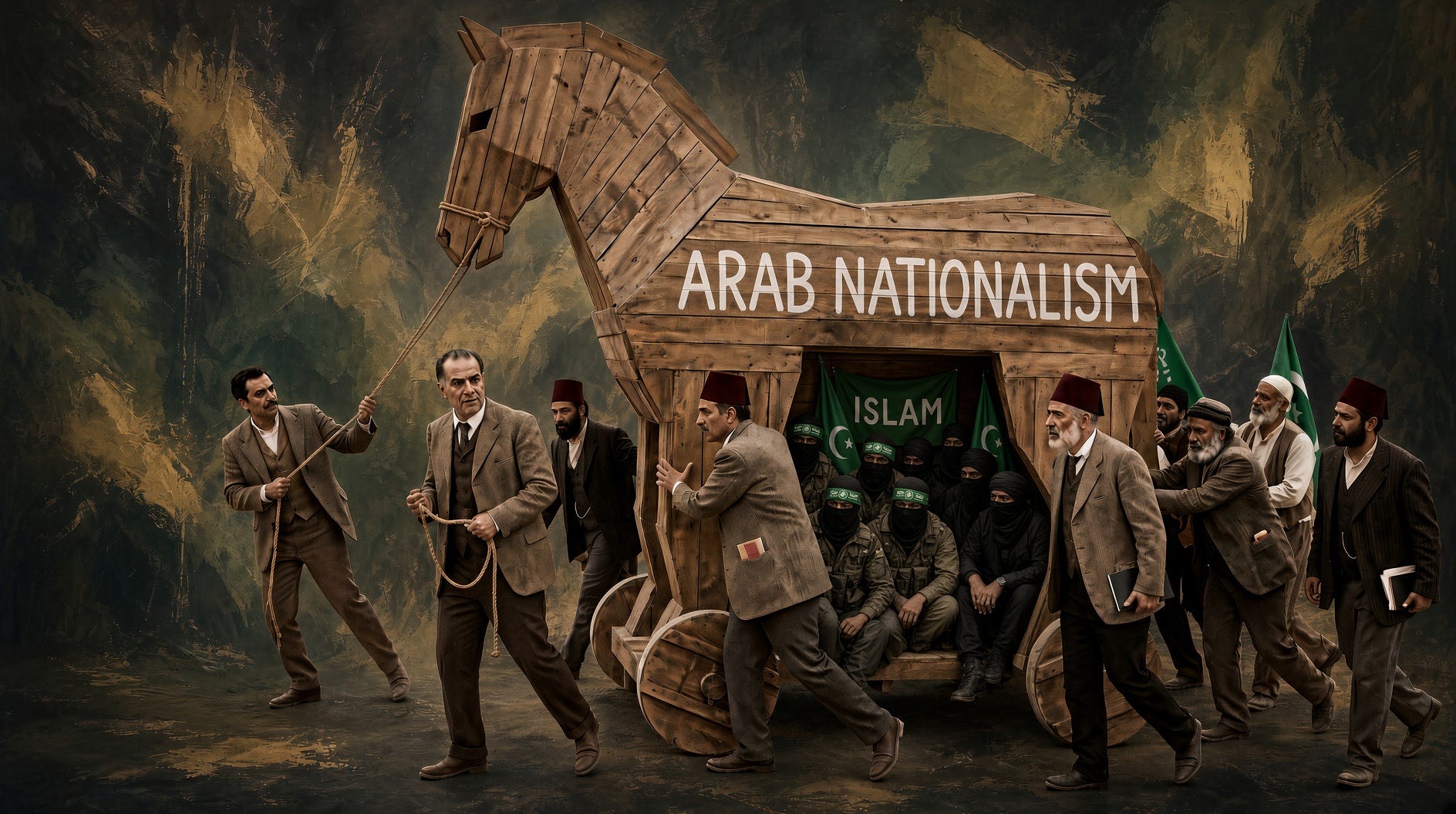
For the first time since the days of Muhammad, the future of the region was open, and no one owned it yet. Arab Christians saw this and decided it was their moment to give birth to Ishmael.